Friday, June 14, 2013

A Selection of Somewhat Random Photos from the First Six Months in Bhutan, Batch #1

Since arriving here in January, I have taken an impressive number of photographs.  Many are not worth sharing, but there are a few that I think might help convey my experience here, as well as the changing landscape of the Punakha Valley from January to June.  I thought I'd post these in small batches so as not to overwhelm.


The Himalayas on the Border of Tibet from Gasa (north of Punakha)
Cat in Punakha Dzong

Dechen, me, Wangmo and Gakey wearing our gift from the King after the Royal Visit

Morning Assembly at school: Girls are wearing their red rachus over their shoulders
and boys are wearing their white linen kabneys. This is formal
wear for the day of our school rimdro when the building was
blessed and purified by monks. Note the sleeping dog.
Prayer flags looking south from Chime Lakhang, the temple of Drukpa Kinley,
the Mad Monk of Punakha. It is believed that if a woman is blessed here
by being tapped on the head with a wooden phallus by one of the
resident monks she will become pregnant.
Thubten Senge walking over the bridge to Khamsum Yulley Namgyal
Chorten (a new temple built across from Kabesa on the Mo Chhu)
I bought this mug in Thimphu!

Monday, May 27, 2013

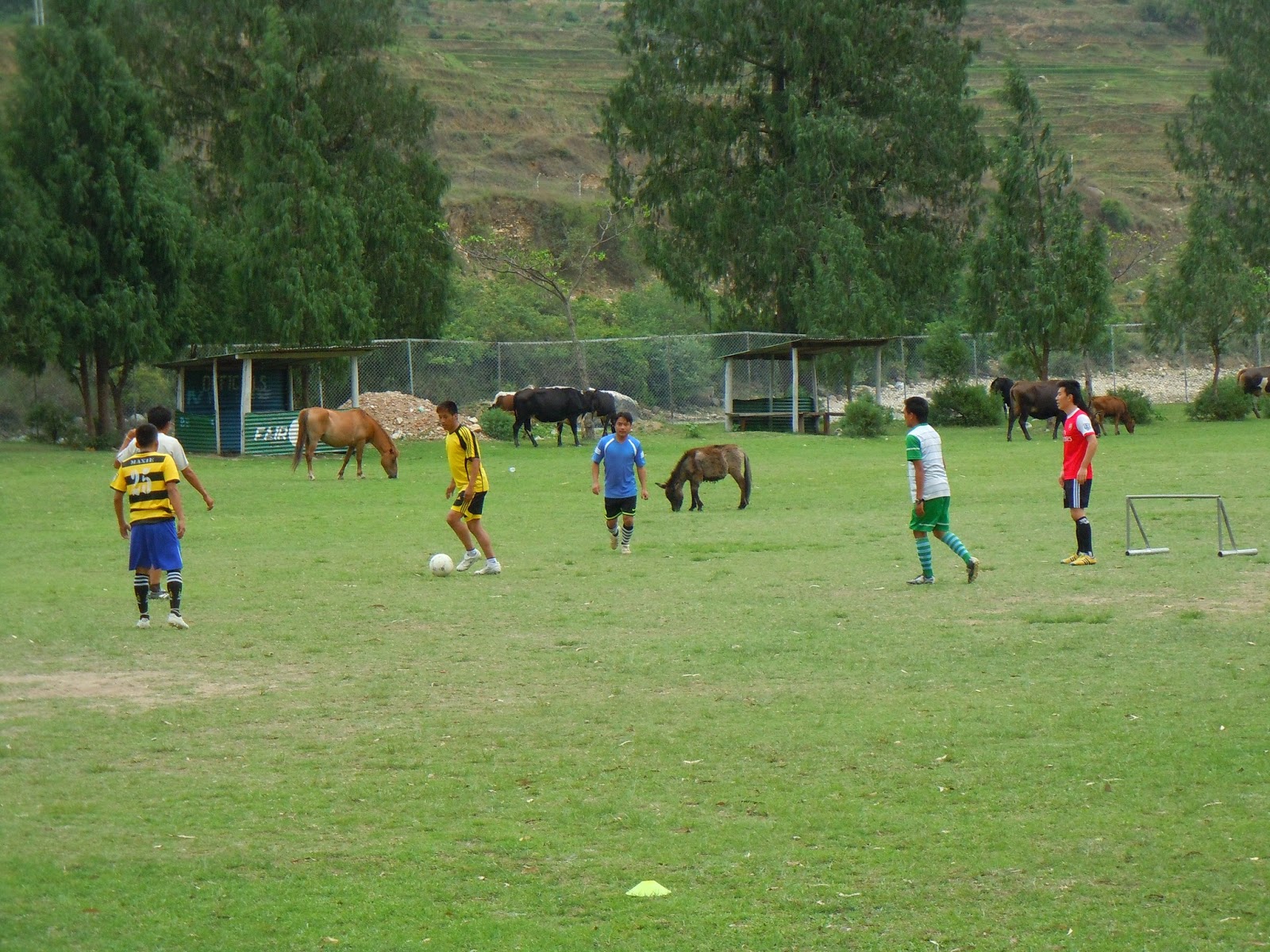
Why I could not go running on the track today

His Majesty the Fifth King of Bhutan's livestock were grazing on the track/soccer field. Tomorrow they will be herded north to Gasa for the summer.

On the soccer field

The real meaning of playing with donkeys

The King's newborn colt

Moo.

Making Momos

Norbu Tshering, his wife, Yangchen, and their two sons live across the Punatsangchhu (the river created by the conjoined Mo Chhu and Po Chhus) in a somewhat traditional Bhutanese house Norbu's parents built for them when they got married.  To describe the house as a "traditional Bhutanese house" is stating the obvious: to preserve Bhutanese culture, all houses are built with the fancifully painted dentils and Moorish-looking windows one sees in all the photos of Bhutan.  What sets Norbu's house apart from a Bhutanese farmhouse is that it does not have a ground floor that was originally designed to house the livestock or an outdoor kitchen, nor does it have the wooden shutters and the slanted rammed earth walls that characterize the hand-crafted farmhouses of Bhutan (these features of the Bhutanese farmhouse--still the most common form of architecture here--are meant to provide stability to the building; the wooden shutters are not like those in the west that fold in on themselves.  Instead, they are solid boards that slide open, and, when shut, keep out the dust, heat, rain and insects while also helping to prevent the walls from cracking, a hazard of mud walls.  The inward cant performs the same function).  Norbu is a fellow English teacher and his wife is a middle school teacher, and they are, in their tastes and behaviors, as urbane as a Bhutanese couple can get without living in Thimphu--their only livestock is a cat named Sando. It is my good fortune that Norbu is a master momo maker and that he invited me over to his house to learn the craft.

There is a variety of momos--beef, chicken, pork, cabbage and cheese.  Knowing I would want vegetarian momos, Norbu asked me to bring a kilo of cabbage and a kilo of maida, the highly processed wheat flour from India that is preferred for its smooth texture.  It was the warmest and sunniest afternoon I've experienced since arriving in Punakha, and I had walked the three miles from Khuruthang to Norbu's, so the chilled Druk 11000 beer (brewed in Bhutan) that Norbu poured me when I arrived slaked my considerable thirst.  

On a hot day it aint bad.  The lager is better.
We sat out on his deck, the imposing and magisterial dzong across the river below, and chatted before Norbu gave me the task of mincing the kilo of cabbage while he mixed the dough for momos.

In Bhutan, there is no such thing as a measuring cup or spoons, so everything is done by eye and feel.  As I sat on a low bench in Norbu's kitchen chopping cabbage, he, with a little help from his son Gephel, mixed what looked like a cup and a half or two cups of maida with perhaps a cup of water that he poured into a well he made in the center of the flour.  To this he added a teaspoon or so of baking powder and kneaded the dough until it was somewhat stiff and only slightly sticky.  

Norbu and Gephel mixing momo stuffing
As he worked, I added several small chopped red onions and salt to the cabbage, and then cut some of the ubiquitous Amul cheese (like American cheese) into small cubes and added that to my mixture, an exorbitant and tasty--but unnecessary--addition.  

Norbu divided the dough into balls about the diameter of a quarter.  These he rolled out onto a small round wooden board with feet designed for this purpose onto which he had put a dusting of flour to keep the dough from sticking.  Each ball made a disc about four inches around and about a sixteenth of an inch thick.  Into each of these he put about a tablespoon of the cabbage mixture, deftly and quickly shaping the dough into crescents with artfully pinched edges.  I tried to follow his lead and make a few myself, but my Ukrainian blood must be thin: my efforts created lumpy wads that didn't stay pinched.  I took over rolling out the dough while he did the filling and shaping.


Rolling out the dough
While we worked, a momo steamer was heating up.  Momo steamers, I assume, can be used to make Chinese buns and any number of other steamed foods and can probably be purchased in the States in any large Asian market.  Comprised of a deep metal pot with two layers of steamer trays and a lid, one simply fills each layer with prepared momos, puts the lid on, and then waits until the dough is just slightly sticky to the touch.  This takes about seven to ten minutes during which time the filling is also steamed, melting the cheese and softening the cabbage and onions.  Yum.
Filling momos

Because in my blog I had said I could eat 15 momos, Norbu insisted that I eat 15 of our momos, so as they came out of the steamer they were piled on a plate with some store-bought ezzay.  Delicious, hot and filling, I tucked into the heap on my plate.  Norbu continued to make and steam them as I ate one after the other.  Just as I was starting on my second plate, Yangchen came home and, after feeding the baby who had been sleeping the entire afternoon, made ezzay from scratch with red chili powder, grated red onions, cilantro, a little warmed oil, and salt (this is, essentially, salsa, and would be fabulous on black beans or tortilla chips).  


Pinching it closed

One completed!
Two styles in the steamer


Ready for the steamer

It took quite a while to use up all the dough and all the filling; from start to finish, I think it took us three hours.  But the recipe made enough momos for a meal for at least six people, unless one of the guests happens to be me!
The first four of fifteen!

Thursday, May 2, 2013

Food in Bhutan #1


People who have traveled through Bhutan as tourists often complain about the monotony and insipidity of the food. It's always the same, they opine, and it is often just indistinguishable goo with tasteless steam-table rice and overcooked vegetables. Often, there is a meat dish that is unidentifiable and mostly bone with a lot of fat swimming on the surface. Breakfast will invariably include fried eggs and toast (since bread is not a staple in Bhutan, the toast is perfectly square white bread redolent with a particularly odiferous and tangy type of local yeast) and corn flakes, served with warm reconstituted powdered milk. The tea is weak milk tea; the coffee is Nescafe. Having spoken to these travelers before my arrival here, I was nervous about being a vegetarian and about becoming bored with the tedium of the same foods at every meal. I need not have worried.

The reason tourists have such negative experiences with Bhutan's cuisine is because they do not actually experience real Bhutanese cooking: the hotels that accommodate tourists seem to cater to a caricature of a tourist--someone who can't handle hot food, who won't eat what looks "weird", who disdains rice, and who likes all the nutrients and texture cooked out of everything. This cartoon traveler MUST have eggs for breakfast and certainly will not tolerate any other hot liquid at meals other than bland tea and instant coffee. Granted, Bhutan, which is just now beginning to develop its tourist industry, has to feed Japanese, German, Dutch, British and American tourists who all have different culinary likes and dislikes, but it seems a shame that Bhutan feels it must forsake its local cuisine as a result.

Real Bhutanese cooking does indeed rely primarily on a trio of foodstuffs that appear in virtually every dish--chiles, salt and oil--but by virtue of the need to be creative with such a limited pantry and because of the influence of Indian and Nepali cooking techniques and spices, Bhutanese food is delicious, healthy (for the average Bhutanese person who labors in the fields all day), inexpensive and easy to prepare.

Students Preparing Chiles for our Teachers' Day Meal

At the heart of Bhutanese cuisine is ema datse, the chili and cheese dish I'd heard about from previous BCF teachers. Very simply, it is hot fresh or dried chiles, sometimes cooked with onions in oil to which is added the local farmer's cheese, called 'datse', and a slice of Amul cheese, a processed orange cheese from India that adds mouth feel and melts quickly. A little water is added to steam the chilies and incorporate the cheese. It is served as a dish separate from, but accompanied by, rice, which is NEVER tasteless or overcooked: Bhutanese rice, usually the red rice sold for $8 a half pound at Whole Foods, is flavorful, something like Jasmine rice, and has a texture I can only describe as al dente; it is chewier than white rice (here, a kilo of this rice costs about $2).

Everyone in Bhutan easts rice three times a day, if not more frequently, and the quantity of rice eaten at each meal is astonishing. I often see students with several cups of rice mounded on their plates at lunch, eaten with about half a cup of a simple potato curry (potatoes are the fourth staple in the Bhutanese diet--again, cheap, easy to grow and transport, and plentiful). Teachers bring their tiffins or their insulated lunch buckets full of rice--probably three or four cups--and it is all gone by the meal's end.
Teacher Meal (from back to front): rice, bean curry, naja,
ema datse, potato curry. The pink container is full of rice;
the red container had a savory and salty fried dough
snack in it.


To vary the diet, ema datse is sometimes made with potatoes or with mushrooms or with any vegetable at hand (beans, for example, in the spring). Indian spices such as mustard seed, cumin, or ajwain may be added. Though it is hard to believe, I still enjoy eating ema datse, the hotter (in spiciness) the better.

Chile choices at the veggie market

Dried local chiles

Perhaps my favorite food here, however, is Tibetan in origin: momos. Anyone who has been to northeastern India, Nepal or Dharamsala knows the momo. It is essentially a piroschki or pierogi, a steamed stuffed dough, here served with ezzay, a sauce of chiles steeped in salt, oil, and spices (the word 'ezzay' actually means salad, but it is usually meant to indicate the chile sauce). The stuffing for momos can be beef or pork, but most often they are stuffed with cabbage cooked with onions, or cheese. When the dough is soft and the filling cooked so that the cabbage is still just slightly crunchy these are delectable. I can eat fifteen of them if left to my own devices.

Cabbage momos and ezzay

Accompanying almost every meal--indeed, accompanying almost every move one makes--is sweet milk tea or naja. Made with loose tea leaves and sweetened powdered milk boiled until the tea is very dark to which is added ginger or cloves or cinnamon or all three, this tea is addictive, though dangerously sweet (it does not, however, approach the sweetness of Indian tea which I actually could not drink). In colder weather or in the evening or when someone just feels like having it, instead of naja there is suja: butter tea. Fortifying, rich, and almost cloying, this tea is not sweet. It is filling and nutritious--if one is trekking across the Himalayas with one's yaks. I think perhaps it is not so nutritious for sedentary teachers and government workers who get their calories from cheese and mountains of rice and naja. Many of us teachers complain about Bhutan Belly, the pudginess that results from a diet that is almost 80% carbohydrates (a pudginess I resent but have to learn to accept as a reality of my new life in Bhutan).

Other foods that are common here are curries, a term used to describe any number of dishes made with mixed vegetables seasoned with ginger, chiles (of course), turmeric, and Indian spices. These are not the curries of the the Punjab or Rajasthan--the use of chiles and the particular mix of spices differentiates them from what we in America think of as a curry.

Preparing a curry

The fast food of choice, aside from the Indian version of Cheetos and Lays Potato Chips (which come in "Tomato Masala" flavor and "American Sour Cream and Onion") is Maggi, Koka or Wai Wai Noodles. These are all essentially salty, spicy varieties of ramen and every restaurant in Bhutan that does NOT cater to tourists has them on the menu as "Chow Min" (sic). They are cooked up somewhat dry and vegetables such as spring onions and beans are added. Frankly, it's pretty tasty and filling. Students here at PHSS buy Maggi noodles at our canteen and, prior to opening the packet, crush the noodles into tiny pieces, then tear open the top and pour in the flavor packet. They then pinch closed the top of the bag and shake the whole thing to evenly distribute the salt and spices. This is their snack, often several times a day (one cannot live on Maggi noodles alone: there is the story of the married couple from Canada who came to Bhutan as BCF teachers and who lived exclusively on Maggi Noodles. They were sent home extremely malnourished, he with infected hemorrhoids).

For a while, my snack of choice was a small, salted, dried plum. The initial taste is overwhelmingly of salt, but when that is sucked off, there is a sweet little plum, like an umaboshi, at the center. There was something about the complementarity of the salty and the sweet that I loved. I became so fond of these, I was eating them like popcorn. I had to stop when I began getting leg cramps at night from being dehydrated from all that sodium.

Dried Plums


NEXT INSTALLMENT ABOUT FOOD: Chile Pops, channa, dal, and how to make an ezzay you can serve at Superbowl Games.

Friday, April 26, 2013

STUDENTS from PUNAKHA HIGHER SECONDARY SCHOOL #2: Dawa Tshering


I am Dawa Tshering and I am 16 Years old. At present I am in 11th grade and my class teacher is Miss Sarah. According to my perspective, I am a humble and hardworking boy. I graduated my 10th grade from a school in southern-Bhutan with exceptional marks.

I would like to share with you my interest. I am interested in listening to music, playing musical instrument, playing games like basketball and table tennis and also making friends with girls. I am a naughty boy but I stay in good manner according to the discipline of our school.

I have experienced many things which I have wished for and I am glad that I have both parents and elders who love me very much.i have many friends from outside the country on FACEBOOK and hope you would also be a good friend to me.

The place where my family lives is Thimphu, the capital of Bhutan. My home town is at Dagapela but my origin is from Punakha and Tashigang. In Punakha the weather is hot and sunny. I am having a little bit of trouble in getting adapted because of the weather condition and school's strict rules and regulations.

Our school is faced upward and the Punakha dzong which is one of the most popular dzong in Bhutan is faced towards our school. We have a park below our school where we go every free period to study and sight see. I think we could be a good friends, if you could share about yourself. What do you like and what don't you like?  .

Your friend in Bhutan,
Dawa Tshering           

STUDENTS from PUNAKHA HIGHER SECONDARY SCHOOL #1 : Chhimi Selden

Chhimi Selden

Life is not a bed of roses. For me life is really challenging since I am from a poor background. My dad left me when I was only a month old. I have never seen him and I miss him sometimes when I see my friends with their dads. Since ninth grade I have been staying with my grandparents because my mom can't afford to send me to school but now I'm living with my mom. Now I'm in eleventh grade. Actually my mom used to stay in Thimphu [our capital] with my step father who is of no use. Since she was having some problems with him she shifted to Punakha [my village] with my two younger brothers. So me and my elder brother decided to stay with her and help her.

As there is no one to help my mom she sometimes goes to work under some people which I hate the most. I wanted to keep her from doing any work because most of the time she feels sick. But we don't have another option as there is no one to help us and  my brother has completed class twelve last year and his marks were not good enough to get him a job. I really love  to help her. Since she goes outside to  earn money, I handle  the chores at home. I do all the  chores at home like washing clothes, preparing meals, cleaning the house, fetching water, giving baths to younger ones as I don't want to give her more burdens anymore. These are the things I do other than studying. I love to study and I have been doing pretty well in my academics. Helping my mom became my passion. Though I don't get good clothes to wear or good meals to eat, still I'm happy because I'm with my lovely mom.

Because of all this I study very hard. Usually many people say that they can't study because there situation is not good and they can't concentrate. But I strongly disagree because for me this situation makes me work really hard, as this situation keeps on reminding me that I have big responsibility to do. To get a job whereby I can help my mom as well as keep her happy. Not only this, my aim in my life is to give the best education to my younger ones. So, I aim to be a Journalist if not at least a teacher.

My questions to all you readers are: What are the things that you do with your parents at home? What do you do besides go to school?

From Bhutan,

Chhimi Selden                 


Sunday, April 7, 2013

The Photo You've All Been Waiting For: Me Wearing a Kira

At Uma in Kabesa
One of the perks of being a Bhutan Canada Foundation teacher is that every once in a while, Sam Blyth, one of the founders of BCF and its biggest promotoer and fund-raiser, travels to Bhutan and takes some of the BCF teachers out for dinner.  Last night, Andrea Giesbrecht, Thubten Senge and I were treated to a five star meal at Uma, a very swank hotel north of Punakha.  I felt it would be appropriate to wear my new, hand-woven kira.  Here I am in it, standing on the balcony at Uma.

Thanks to Sam for a really lovely evening and a break from saag and ema datse!