Sunday, October 27, 2013

"Hidden-Ox-Rock": A Transformative Hike to Beylangdra Monastery

Beylangdra Monastery, Wangdi Phodrang

Like Takstang in its apparent ability to defy gravity, Beylangdra Monastery is not otherwise visually impressive: recently completely rebuilt, it does not convey the stalwart enduring quality that Takstang does, nor does it reveal its considerable history. However, the handful of monks in residence there, some of whom recently completed their twelve year retreats, awaken in the receptive visitor a sense of belonging, light-heartedness, and mystery unique--in my experience--to Buddhist monasteries. Granted, I had a distinct advantage: I visited Beylangdra with my friend and colleague, Thubten Senge, a Nyingma monk who had previously visited and who was returning to participate in the Descending Day puja (Descending Day, or Lhabab Duechen commemorates the day in the Buddhist calendar that Lord Buddha's emanation returned to earth from so-called Tusita 'Heaven' where he had gone to preach to his deceased mother and the gods).

Beylangdra lies at the end of a stunning valley, 22 kilometers from the turn-off at Chuzzom in Wangdi. Those are 22 rough, rocky, bone-shattering kilometers, but when one tumbles out of the car, it is only an hour's hike up to the temple. If one wishes, one may first stop at the small lakhang that looks, observed Senge-la, like a cereal box: it is simple and square, and serves a small community of young monks who attend the lobdra (school) associated with it. 


Lakhang below Beylangdra

Behind the lakhang and up a short path is one of the retreat "huts" where a monk might spend three or twelve or even twenty years in silent meditation. There are more, smaller huts next to the monastery as well. Marking the half-way point is a shed housing butter lamps and another with prayer wheels both inside and out. The very devout stop here to increase their merit by sending prayers into the karmic soup by spinning the wheels and lighting lamps as they recite their mantras ('Om mane padma hung' being the most commonly heard, but there are countless others).

Prayer wheels

Butter lamps
According to one of the resident monks, Beylangdra was founded in the 8th century and is yet another of the many sacred spots where Guru Rinpoche is said to have meditated in a cave. Around this cave the temple and retreat center have been built, clinging to the cliff face. There is a newly constructed wooden building overhanging the valley where one can leave one's backpacks or sit and rest or reflect, and below that are the monks' kitchen and toilet. The altar room is in a separate building--the one whose back wall is actually the cliff.

This wall is the key to the "hidden" reference in the monastery's name ('bey'). Concealed by the altar, the black cliff face (dra means rock, as in Bey-lang-dra) has a round impression at about knee level that is believed to be a sealed chamber in which are sacred terma--treasures hidden by Guru Rinpoche that can only be revealed by the preordained terton, or 'discoverer of terma.' The Tertons are reincarnations of Guru Rinpoche's original 25 disciples, some of whom are alive today. The terma themselves are of two kinds: some are actual texts or ritual implements or images; others are in the mindstreams of the reincarnate tertons. There are terma hidden all over Tibet and Bhutan, some of which have been discovered and shared with the world, but many of which are yet to be released from their hiding places. The statues in the altar room disguising the portal to the terma are of Pema Lingpa (himself a terton), Dorji Lingpa, an intriguing wrathful representation of Guru Rinpoche as he subdues the demon lang (ox) and, at the center, Chenrezig, the bodhisattva of compassion, in what is called the 'yab-yum' pose, representing the unity of male compassion and female wisdom (I had never before seen a yab-yum statue on an altar in Bhutan).


Chenrezig (Avalokiteshvara), the Bodhisattva of Compassion
in the yab-yum pose
When we arrived, we left our packs in the wooden 'welcoming' building, took off our shoes, and climbed a short staircase to a typically steep ladder, emerging into the altar room. The monks were performing the days' puja, reciting prayers as offerings, accompanied by the inimitable honking, crashing and thrumming that serves as the score to Buddhist prayer. Bhutanese from all over central and western Bhutan arrived with bags of dalda (the oil used in the butter lamps), incense, Wai-Wai and Maggi noodles, red and green and yellow packets of biscuits, chocolates, apples, guavas, and, of course, money. All this was heaped in a pile in front of the head lama and attended to by a young monk who kept the pile from spilling into the area reserved for prostrations.

Offerings
Everyone who comes to a lakhang or other Buddhist devotional site does prostrations, regardless of age or encumbrance. 

Little girl prostrating

Mother with baby in kabney, prostrating

In Bhutan, we first prostrate three times in the direction of the head lama's seat to acknowledge his power, and then make at least three prostrations to the figure at the center of the altar which is simply a physical representation of our own inherent Buddha nature. After Senge and I completed our prostrations, one of the monks performing the puja whom Senge had previously met called him over and gestured for him to sit with them; another monk found me a seat at the end of the line of monks so that, had I been dressed differently and shorn of my hair, I could have been mistaken for one of them (except that I can't sit in a lotus pose).


The altar.  The objects in pink, blue and yellow next to the statue are
made out of sculpted butter.

I welcomed this opportunity to try to meditate, but I am not yet adept enough to prevent myself from being distracted by the people coming and going, the monks chanting, the slinyen crashing, the dungchen blurting, and the incessant pounding of the nga. Nevertheless, I tried hard to focus on my breath until the old monk next to me elbowed me in the ribs and chin-pointed towards Senge. He was grinning at me, raising his eyebrows to ask, "You ok?" Indeed, I was better than ok.


Monks performing puja; Senge is beating the nga.
Note the kangling, the two horns on the floor
traditionally made out of human thighbones.

And here he is blowing on the conch


Despite the din and the controlled chaos of the devout bowing and circumambulating and handing out cash to the monks, I felt a sort of giddiness--a sense of simple, unaccountable happiness. This feeling was not at all like the profound emotion I had at Takstang; there, I had been overcome with an awareness of the power of the place. Here, it was just me in a beautiful place with people who radiated a contagious playfulness and calm affection and true wisdom.


Playing the dungchen
After a few minutes, the music stopped and the monks all rose and began to leave the altar room. "We've been asked to lunch," Senge said, and so we joined the monks in their 'dining room' for suja, red rice and ezzay.

In a line, we walked back down the inhumanely steep ladder (nearly every traditional building in Bhutan has these--it is a mystery why they have to be so steep except that the steepness preserves living space) and the stairs and then down another short flight of stone steps, past the reeking toilet, through the 'kitchen' which had four enormous curry cookers in it, to a narrow, dank and soot-blackened cement room with a cement counter on which were three large battered aluminum pots. One was full of red rice, one of mushroom datse, and one with green beans. A bowl of simple ezzay--just green chiles, datse and onions--sat nearby. One plastic chair was placed by the window which provided the room's only light. It offered a particularly vertiginous perspective on the green and gold valley below. On the plastic chair sat a gray haired man in a stinking gho who was cutting chiles. He graciously vacated the chair for me as lunch was served, and a delicious lunch it was. 

 As we ate, Senge and Lama Tandin, a youngish monk with a lame leg (which is what got him into a monastery in the first place--his parents sent him because they were concerned he'd be ostracized at a public school) joked about the challenges of learning English during a twelve year retreat. He wore his long, shiny black hair in a pony tail, the length of which indicated how many year he had spent in retreat. A few of the other monks also had long hair tied back, and a few had added a surprisingly stylish twist to his monk attire: Lama Tandin was wearing a white Chinese "silk" Mao shirt under his robe with red and gold trim. Standing quietly nearby was Lama Kunzang, a tsampa chenpo (someone who has completed a twelve year retreat), observing. A very old monk with stringy, long gray hair, a large furry mole and a crooked yellow fang stood at the back of the room rolling two handfuls of rice mixed with butter in his hands. I was later told that this was because I had unknowingly commandeered his plate, but in the monasteries when monks have their lunch, it is often while they are in the lakhang in seated prayer. They place a white cloth on their laps and open their hands to receive their rice from a monk who carries a large bucket of it and ladles it out; when the rice is rolled into a ball, it is easier to eat. So he was used to it.


Handful of rice
Though neither Senge nor I speak Dzongkha, Senge can speak Chokyi (classical Tibetan) which many monks understand, so he was able to communicate with relative ease. He chatted with Lama Kunzang about the difference between his own mind and the mind of someone who has meditated for twelve years.  "I see everything clearly and you don't," said Lama Kunzang.  For him, there is no real distinction between the subject and the object: he sees what is called Mind in all its luminous clarity (this is how Senge explained it to me later, but I am not certain I have it right). 

Before embarking on this adventure, I had asked Senge if he'd be willing to translate for me so that I could have a few questions answered about rebirth and the bardo, so halfway through our enormous portions of rice, he asked my first question: Why is it important for a Buddhist to believe in rebirth? Though Senge succeeded in asking the question, translating the answers was another thing, so Senge went up to the lakhang and recruited three reluctant Bhutanese to be our translators. The sophistication of the vocabulary and concepts needed for this discussion was understandably beyond their language ability, and so after they provided their own answers ("You have to believe in it in order to have a better rebirth!") we released them.

I did not get an answer to my question (yet). However, Senge then asked if Lama Tandin or Lama Kunzang could offer me any pointers for a beginning meditation practice. Both demurred.  In the Nyingma tradition, one of the four central vows is that one will not lie about his religious accomplishments. The result of this vow is that most monks will not admit that they know anything about Buddhism. Lama Kunzang's reply was, "She should ask her teacher." As if I have one. But Senge pressed on, and by the end of our lunch, Lama Kunzang and I agreed that he would be my teacher and would provide instructions on meditation techniques. He will provide them, he said, on the next auspicious day in the Buddhist calendar (like the Tibetan and Chinese calendars, it is lunar) in English, via mail.


Lama Kunzang

Some of the monks of Beylangdra with Senge. Lama Tandin is on Senge's left.

After lunch the puja continued.  During this period of prayer, Lama Kunzang tied a red thread around my neck--a sign of blessing and protection that all Buddhists wear.  I have had many of these tied around my neck and not one has lasted longer than a few days.  I was hopeful that this one would last.*  He then showed us the hidden rock where Guru Rinpoche hid the terma and explained that it was on the site of this monastery that he had subdued the demon in the valley that took the form of an ox (lang); hence the wrathful expression and posture of the statue in the altar room, and hence the name of the monastery: hidden-ox-rock.  At about 2:30 the monks took a break, and Senge and I joined them for one more cup of suja (butter tea). We were invited to stay the night so that we could continue our discussions, but we had left our taxi driver waiting at the lakhang below.  We expressed our gratitude for the monks' generosity and said our reluctant goodbyes.


A Wrathful Guru Rinpoche

In my decades of exploring Buddhism I have met many teachers, some western and others from Tibet, India and Nepal. But there was something different about Lama Kunzang and the other Beylangdra monks. The monks at Beylangdra were remarkably warm and unpretentious, and it was clear that they were eager to be helpful to both Senge and me in our respective practices.  Perhaps I have been transformed: maybe Bhutan has made me ready to receive whatever teachings Lama Kunzang can provide. Or maybe it was Senge's artful facilitation. Or, as my Buddhist friends and students would assert, it was just my karma to finally find a teacher on the Day of Lord Buddha's Descent from Tusita Heaven in a remote monastery at the end of a pristine valley, just past the 150 foot, 1200-year-old cypress tree that arose from Guru Rinpoche's walking stick, a tree that symbolizes the enduring power of the Dharma in Bhutan.


Guru Rinpoche's Cypress below Beylangdra


* My red thread fell off as I was making dinner the day after we had visited Beylangdra.


Tuesday, October 1, 2013

EZZAY: Bhutan's OTHER National Dish

Photo stolen outright from BCFer Andrea Chisholm's blog,
"From Down Under to the Top of the World."  She makes a
bee-uuu-tee-ful ezzay! (Thank you, Andrea)


For a primer on the how and what of ezzay, Bhutan's ubiquitous 'salad,'
click on the this link:

Ezzay Primer

Thursday, September 12, 2013

All One Hundred and Twentynine of My Students (except one, who has a boil on her arse)

My Class: 11 Arts B


July and August were, as predicted, hot.  Punakha received less rain this monsoon season than usual, but it appears that the rice crops are unaffected: now, in mid-September, the rice is tall and luxuriant and a green that is so intense it hurts the eyes.  I remember arriving here when the paddies were brown and dry and the evenings cold enough to warrant long johns and a space heater.  I guess those days will soon return--the heat has given way to a subtle coolness and a lovely autumnal sun with night falling now at 6:30. 

I took advantage of an especially stunning day during midterms--when all the students and I were unsuccessful at focusing on schoolwork--to have 'class photos' taken.  I am wearing a kira because the Dzongda (a political position like a governor) and the Director of Education had visited the school that morning to award our ten 'toppers' (the students who are the top scorers on exams) with certificates from the King.  In these photos I am sporting perhaps the worst haircut I have ever gotten, but I paid exactly $1.00 for it and it took ten minutes.

Below are just a few photos of me with my lovely students.


Arm wrestling with Sonam from 11 Commerce B
My 11 Arts B Captains: Ngawang Choden and Jigme Paldon Shangson Rai
(A 'captain' is a class leader, appointed by the 'class teacher'--sort
of a glorified homeroom teacher. 11 Arts B is my class.)

Chhimi Selden, 11 Arts B, and I


The Boys of 12 Arts B
Girls of 12 Arts B


Class 12 Arts B, All 46 of them!


Kanjur Om, me and Suresh Rai with a great shot of the Dzong

11 Commerce B

Some of the cool boys (and Pelden) from 11 Commerce B


Class Captains, 11 Commerce B


Tuesday, August 6, 2013

What I Did On My Summer Vacation: MERAK

Merak, as seen from Gangu

It is hard to believe I was really in Merak, that it actually exists, that a nomadic group of Tibeto-Burman people, the Brokpa, who do not dress or look like other Bhutanese still manage to thrive and maintain their ways of living.  Hand made houses built of dry stonework, mostly tiny single story, one room dwellings, are stacked up the mountainside. These houses do not have the traditional Bhutanese windows, decorative painting and cornices, elevated roofs, open attics or first floor paddocks.  There are no chimneys except in the rare homes with Bukharis--most people vent their cooking fires through a small triangular hole built into the wall.  Smoke also escapes through the cracks between the bricks, a very inefficient and COLD solution. The paths between the houses are narrow and rocky--and muddy in the summer. Livestock--the pack horses that travel to Tashigang for supplies and the yaks and dzhos that provide milk for cheese and butter and hair for clothes--wander the paths and graze lazily wherever they can find forage.  


Going to school in Merak. There is only a primary school--once kids complete
6th grade, they go to a boarding school in Phongmey.


A pack-yak outside a Merak home

Merak roofs


The Brokpa people are stocky compared to other Bhutanese and are inhumanly strong (on the path down to Phongmey, we passed a man with skinny legs wearing flip flops carrying on his back a metal desk all the way to Sakteng; another came up the trail with a refrigerator strapped to his back).   They do not wear the ghos and kiras mandated by the Bhutanese government as a sign of citizenship.  Instead, the men wear a red wool jacket cinched tight with a gho belt over which they often wear an animal skin poncho.  The women wear red and white striped wool dresses and the trademark Brokpa hat: a yak-hair beanie with five spidery that legs that draw the rain away from one's face (in one of the few truly touristy acts of my time here, I bought one of those hats).  In this region of Bhutan, the people Gelugpa Buddhists--they revere the Dalai Lama rather than Guru Rinpoche or Longchempa.


Brokpa women wearing their very cool hats and characteristic dresses

Man in a Brokpa jacket loading a yak

We woke in Merak to the surprise of high clouds and, blessedly, no rain.  Brick had gotten up before me and had found the elusive caretaker of the guesthouse, securing for us a real bed for that night with a Bukhari for $2 a night.  We encountered a group of three Bhutanese young men in a large tent in the schoolyard outside our classroom 'hotel,' one of whom owned a tour company in Thimphu.  He and his two friends were exploring the Merak-Sakteng area as tourist destination and invited us to join us at the village lakhang for the end of the annual community rimdro (a religious purification ritual).  Determined to see as much of Merak as possible, we told them we would meet them there later, and we spent the morning meandering aimlessly, completely enchanted.


The Merak Lakhang
When we arrived at the lakhang it was lunchtime and the dogs knew it: they were lined up outside the community kitchen (all villages have a kitchen near the lakhang where food is made and served during festivals and other public events) waiting for leftovers.  
Dogs outside the kitchen hoping for lunch. Notice the traditional
Bhutanese roof: tiles of slate held in place with rocks.  One sees this
all over the country, even in the capital, Thimphu.

We visited the tiny old lakhang as the monks rested from their chanting and took some tea, noting the countless photos of the current Dalai Lama on the altar.  Nyengda, the owner of the tour company, came and got us so that we could join him and his friends Sonam and Thinley for lunch in the community kitchen in the building next to the lakhang.  As we watched a monk fashion torma, the sacred sculptures made of colored yak butter that decorate the altars of all lakhangs, we were given enormous momos that had been fried in a vat of salty yak butter with a side of ezzay, the fiery chile "salad" that accompanies almost all meals in Bhutan.  The ezzay was so salty neither Brick nor myself could eat more than a few bites.  This did not deter the dogs: after all the humans had eaten, the scraps were put into a trough outside the lakhang where the dogs had a field day.


Dogs at the trough. Note almost all of them are Tibetan Mastiffs mixed with
something else, except that cute little tan puppy wedging himself between two others.
Nyengda had arranged to film a performance of a traditional dance which wasn't normally done during the summer, but the dancers obliged so he could film them for his promotional materials.  Vigorous and athletic, it looked to me to be a dance about the Megoi, but we were told that it was the Iron Bridge Dance (the Bhutanese have a real fascination for bridges which makes sense in a country with so many rivers to cross) about a spirit who threatens to sabotage the construction of a bridge, but a powerful lama stops him (or something like that).   The rain had begun long before, so the dancers were stamping and spinning in huge muddy puddles, splashing their audience and each other.  Best of all, a young boy in pink overalls stood behind the dancers and accurately mimicked every step, hand gesture, and facial expression of the middle dancer; the boy's level of concentration, accuracy and sheer joy was more engaging than the dance itself. 


Iron Bridge Dance

Boy imitating the central dancer


Merak Brokpas watching under protection from the rain
After the performance, Brick and wandered down to the school where local students home from boarding school and college were practicing traditional Bhutanese dances for a cultural program they were planning to put on for their parents the next night.  We passed a woman washing saag (greens) in a public tap and bought some from her, and some potatoes from one of the two shops in Merak for our dinner.  The shop was dark, lighted by one dirty window, and was recognizable as a store only because of the huge pile of Druk 11000 bottles stacked outside.  Both shops sold the same items: Wai Wai noodles, incense, crackers, toothpaste, mango juice and beer--the basics.  Everything else is grown or made in Merak: their clothes, saddles, ropes, furniture (there is almost none), cheese, butter.

After a surprisingly satisfying meal of Wai Wai noodles augmented by the potatoes and greens we had bought, Brick and I sat by our Bukhari as night fell.  We would be leaving early in the morning with Nyengda, Sonam and Thinley for Sakteng.  They had hired horses to carry their gear; we decided it was a good idea and so hired a horse of our own to carry my pack in which Brick would put the heavy items from his pack.  Though the 9 hour hike to Sakteng would take us over Nyuksangla at 14,ooo feet, I was sanguine about hiking without a pack, rain or shine.  But I was sorry to have say goodbye to Merak.

Anomalous tan puppy in Merak trying to stay dry.


Sunday, August 4, 2013

What I Did On My Summer Vacation: Phongmey to Merak, Day 1

As every student's speech in Bhutan begins with a quotation (or a "thought for the day") which has absolutely no relevance to their speech, here is an introductory quotation for this posting:

"Tourists don't know where they've been. Travelers don't know where they are going." --Paul Theroux

But this is relevant.

When my friend Brick Root and I began talking about spending our abridged summer break in eastern Bhutan, I had an inchoate notion about where we might go. I'd heard it was wet, it was remote, it was too far, it was rife with hideous leeches and, most compelling, it was "the real Bhutan."  

Punakha is somewhat derisively referred to as "the city" by my eastern compatriots. There are paved roads; a hospital; restaurants; and, most coveted of all, internet access. But to those from the west, Punakha is hardly a city. It has all those things, for sure, but it is still a large village surrounded by rice paddies where cows sleep in the streets and chickens come in one's front door. That doesn't happen in New York. Not often, anyway.

Thus, the thought of somewhere even further removed from what we've come to call civilization was very appealing, and Brick and I decided we would head east after our retreat in Bumthang and go as far as time and weather and roads (which are often blocked by landslides and flash floods) would permit.

The dzonkhag of Tashigang is the farthest east one can get and still be in Bhutan; it shares a border with Arunchal Pradesh, now part of India but not too long ago a kingdom in its own right that was traditionally considered by China to be "Southern Tibet." Indeed, the sixth Dalai Lama was born in Tawang, the area just on the other side of the of the Merak-Sakteng Wildlife Sanctuary. This preserve was established in 2003 to maintain wildlife and botanical diversity, but also to protect the habitat of the Migoi, better known in the west as the Abominable Snowman. Really. It was at first opened to tourists but then closed almost immediately. It has just recently been reopened for tourism, so very few westerners have been there. This was where we decided to go.

After a two-day taxi ride from Bumthang through Mongar and into Tashigang (for western travelers, taxis are an affordable form of transportation but they are too expensive for most Bhutanese who take the crammed, cheap buses I wrote about in my Phobjika entry), we rode the last leg of the long journey without incident, over mountain passes that were blanketed in impenetrable mist, along pitted, tooth-rattling roads, and into the city of Tashigang. Tashigang is the most populous of all the dzongkhags in Bhutan, which seems counter-intuitive since Punakha and Thimphu, the capital, are both in western Bhutan. It didn't appear to be populous: we walked around the entire town in about fifteen minutes. Apparently, most of the population is in the villages which are larger than those of the rest of Bhutan, and Sherubtse College, the oldest college in the country, is there as well, adding to the state's numbers. After a night at the KC Hotel, highly recommended by our eastern BCF colleagues, we headed for Phongmey, a tiny town virtually at the end of the west-east road. BCF teacher Becky Story is a teacher there, and she kindly offered us her "mouldy hut", as she calls it, for the nights before and after our trip into the Merak-Sakteng reserve.

We arrived there in a driving rain that threatened to cut off access to the town. When it rains in Phongmey, the road, which goes right through a river (not over it), is flooded, in which case one has to climb into a metal cage suspended on a cable and pull oneself hand-over-hand from one side of a very steep gorge cut by the torrential river to the other. I was secretly hoping we would have to do this, but, alas, the road was navigable, though just barely.

If you look very carefully, hanging over the river--which is in the middle of the road--is the cable car
(it is painted yellow)
.

A car crossing the river in the road from Phongmey

DAY 1: From Phongmey to Merak, July 5

When we woke in Becky's sodden concrete-block house, it was still raining. Hard. Through the local high school Vice Principal, we had managed to arrange to have a high school student, whose brother lived in Merak, guide us. Sangay Tshering, 15, arrived at 6:30 am, an hour earlier than we'd planned, dressed in flip-flops, track pants, and a thin sweatshirt, carrying a small bookbag. I sheepishly crammed my fancy backpack with layers of fleece, a sleeping bag and pad, some Wai Wai noodles (ramen) and Oreos, extra water, toiletries, and an umbrella, all of which, when compared with Sangay's spartan accoutrements, made me feel like I was wearing a diamond tiara to a mud wrestling competition.

I admit I was reluctant to embark on this crazy adventure: it was pouring; I am sensitive to altitude and on day two we would be hiking from 3000 feet to 14,000 feet in one day; there was no map (maps are uncommon in Bhutan); and our guide was a bashful 15 year old I'd never met who spoke only a few words of English. But what the heck, you only live once.

So we went.

Almost immediately, the trail--actually, a dirt footpath made by cow-herders and farmers to avoid walking on the rutted, rock-strewn unpaved roads--became vertical. In the driving rain, the path was like potter's slip, covering our boots and making our footing unreliable. Sangay marched confidently up in his flip flops as though he were on concrete, stopping every once in a while so we could catch up (we came to covet his flip-flops: he easily and frequently stopped and washed off the mud, and wet flip flops dry almost instantly. Hiking boots don't).

The path crossed the road every now again, and after about a half hour of steady climbing, I heard a tractor coming up the road. Tractors in Bhutan aren't like tractors in the States. They are actually motors with a seat to which one can attach a trailer for carrying goods or people, or a roto-tiller, which is what they are most commonly used for. At the wheel was a jolly, bearded farmer and in the attached trailer was his young daughter; both were going up the mountain to check on his workers in the fields. Neither seemed a bit affected by the rain or by the horrific condition of the road. He gestured to us to hop in, so we did, and what ensued was a hilarious butt-bruising, slurry-soaked trip that nearly catapulted each of us off into the road. We had to get out twice to push the tractor out of the mud, but we eventually made it to his farm. He told Sangay in Sharchop (easterners do not speak Dzongkha) that we were invited in for tea, but we demurred, eager to keep the momentum going. We bid him a warm and appreciative farewell.

We hiked up and up, banked by orchids and rhododendrons, plucking leeches off one another, my boots full of water. After three hours, soaked to the skin, hungry and tired, we came to Kharbaling, the first village we'd encountered which is, according to trekking websites (hikers beware!), the site of a guesthouse and a recommended overnight stop. Fog and mist drifted eerily, obscuring any view, making it impossible to see if there were even any houses.


Karbaling


In Karbaling.  Sangay had changed into his gho to make hiking in mud easier.

Sangay assured us there was a big house and we could ask there for shelter while we ate lunch. We literally stumbled across a deserted one room stone house where a skinny cat yowled and ran. Sangay found the 'big house', but it too was deserted. The guesthouse was ramshackle and locked tight; its roofed porch, where we decided to huddle, was covered in animal dung. We scraped away enough pooh to sit and have a lunch of hard boiled eggs, carrots and cheese and crackers. And then we pushed on. Up and up.

The rain began to abate, thank the gods, and the path became rockier and wider. A dilapidated wooden gate marked some sort of dividing line between the upward hike and a blessedly less steep trail.

Mysterious gate

 Huddled under a tree, drinking cheap Bhutanese rum was a man with a rainbow umbrella and a pack horse. Sangay addressed him in Sharchop but the man was a mute; he grinned and gestured and somehow Sangay understood everything he 'said.' He and his horse became part of our bedraggled convoy and he and Sangay kept each other company all the way to Merak.

Our silent companion
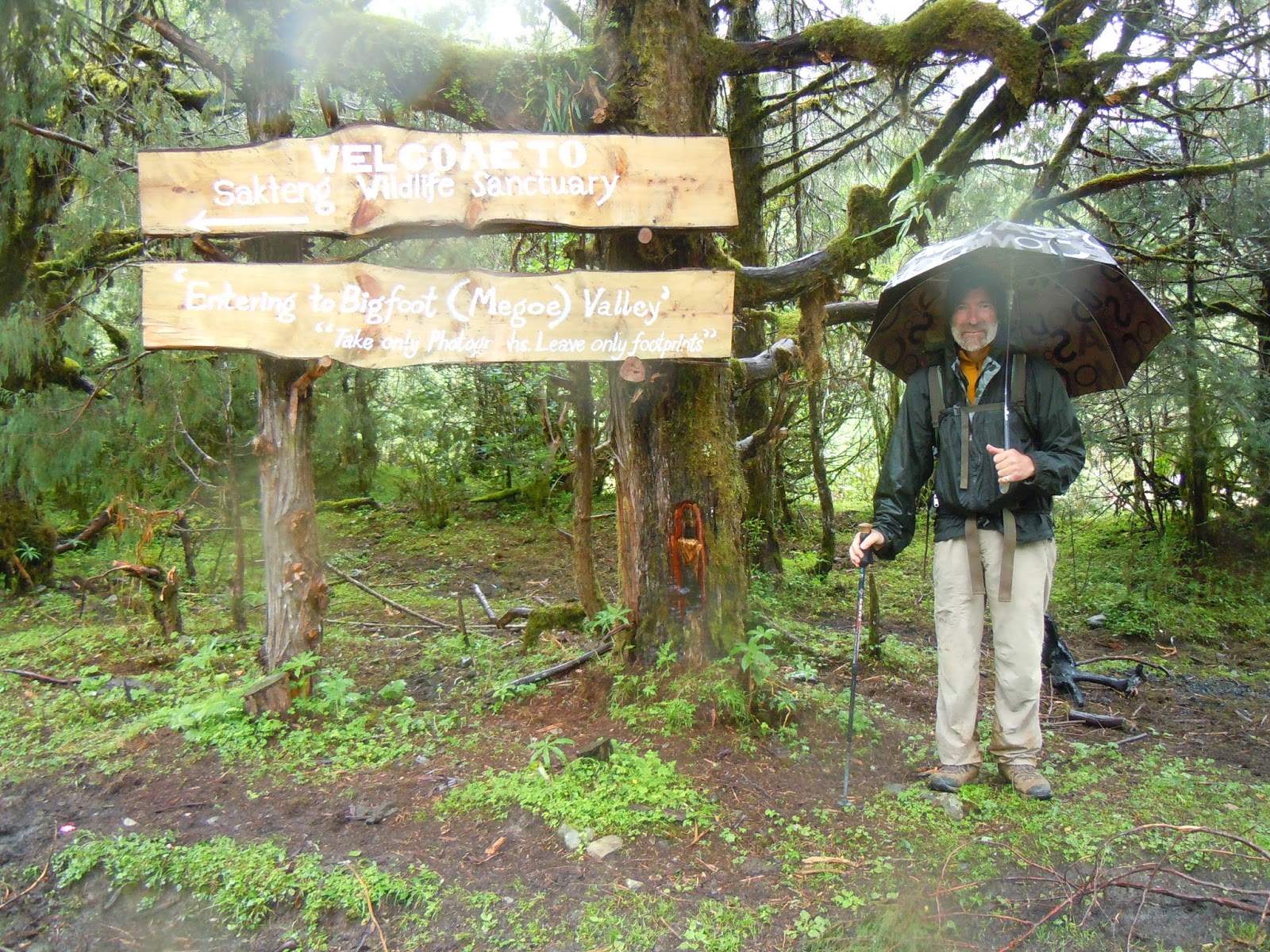
Eventually, the trail wound around until it paralleled the sometimes wide river valley of the Dongme Chhu. Here, finally, we came across the official sign for the Merak-Sakteng Wildlife Sanctuary.

Brick at the "entrance" to the Sanctuary. I don't think very many people,
other than locals, have seen this sign.  It reads: "Welcome to
Sakteng Wildlife Sanctuary. Entering to (Migoe) Bigfoot Valley"
The trail paralleled the Dongme Chhu (or Damnongchhu) for many kilometers.


Beyond that point, the landscape changed and the hiking became more like walking and the rain stopped. Then, unaccountably, there by the riverside in what felt to us like the middle of nowhere, someone had painted stunning, detailed portraits of the Buddha, Guru Rinpoche and Chenrezig, the emanation of compassion. The paintings weren't quite completed; the staging the painter was using was still there, as were some of his tools. At the edge of the river, the painter had erected a rude shelter with a tarp and some branches, the floor strewn with juniper boughs (burned by Buddhists as offerings) and we sat under the tarp to appreciate his art. I would have been content to sit there for a long while; my back and shoulders were knotting up miserably and I couldn't adjust the pack to fit better--but Brick was anxious to get moving: the sun was beginning to sink behind the mountains, so we continued on.


Sangay insisted we were getting close to Merak, but in Bhutan "close" and other references to distance have little meaning, so we didn't give credence to his assurances. We came across a man in bright blue gumboots carrying an empty bamboo basket that most farmers use to carry everything from cattle feed to manure (carrying an empty basket is considered bad luck; maybe he had something in the bottom of it because after we met him, our luck improved markedly). He also joined our parade, chatting now and again with Sangay and the mute man with the horse and smiling at me and Brick in that warm, welcoming way Bhutanese smile.

Somehow, we came to a point where Sangay knew we were only 6 kilometers from Merak. As our shadows lengthened ominously and my back screamed in pain and my energy flagged, I asked the mute man if I could put my pack on his horse for the last leg of our trek. Sangay negotiated, and in the end, the man with the blue boots took my pack, affording me indescribable relief. The sun, hidden for the ten hours we'd been hiking, suddenly emerged from the mist, warming our soggy bones for the first time in days.

We entered a tiny village called Gangu, and off in the distance in a wide, treeless expanse hanging off the side of the mountain, we could see Merak.

The whole group (except Brick; he took the photo)
and a local at Gangu.
At this point, even Sangay and Brick admitted they were spent, but the promise of a place to rest and eat and sleep pushed us forward. We stopped at the first building we came to, a brand new community center built by the Swiss government just below the Gup's office and said goodbye to our friends.  I tried to give the man who carried my pack some money, but he shooed it away, bowed slightly, and disappeared. The man with the horse headed for home. We were hoping to ask the Gup (the local village leader) about how to get a bed in the government guesthouse we'd heard about, but the Gup was not in his office. A young man in the community center, a brash, serious college student home for summer break, assured us that the guesthouse caretaker was not available, so we'd have to find somewhere else to sleep. Bone-tired, we asked the young man where we would find the Principal of the local primary school. Since we are teachers, school administrators are a reliable source of information and assistance all over Bhutan, so we were relieved when the young man pointed to the archery range and said that the man in the black jacket was the Principal.


Entering Merak.  It is said that one of the stones on the
path into Merak is where Aum Jomo, the local deity,
stopped to rest and left the print of her vagina
on the rock.

The sun came out at the edge of Merak.


Brick went to talk to him as Sangay and I rested, and when he returned we had a place to sleep: the floor of a classroom.


First night's lodging.  Sangay went to stay with his brother.

 The Principal also told us that after we stashed our gear we should come to his house to get a water boiler so we could heat our noodles. When we got to his house, warmed by the fire in his Bukhari, essentially a wood stove vented through the ceiling, he took pity on us and had his wife and niece feed us eggs cooked in at least eight tablespoons of butter, saag, rice, tea, and, for Brick, a form of Batu, or meat soup with homemade noodles. We could barely keep our eyes open seated by the warm, dry fire with full bellies. It was splendid.

We went to sleep at 9:30 with a plan to spend the following day exploring Merak. Blessedly, as we nodded off, there was no sound of rain.


A train of pack horses from Tashigang entering Merak. All goods
have to be packed in except what can be grown or made in Merak.
Me and Brick.  Very wet.