As every
student's speech in Bhutan begins with a quotation (or a "thought
for the day") which has absolutely no relevance to their speech,
here is an introductory quotation for this posting:
At this
point, even Sangay and Brick admitted they were spent, but the
promise of a place to rest and eat and sleep pushed us forward. We
stopped at the first building we came to, a brand new community
center built by the Swiss government just below the Gup's office and
said goodbye to our friends. I tried to give the man who carried
my pack some money, but he shooed it away, bowed slightly, and
disappeared. The man with the horse headed for home. We were hoping
to ask the Gup (the local village leader) about how to get a bed in
the government guesthouse we'd heard about, but the Gup was not in
his office. A young man in the community center, a brash, serious
college student home for summer break, assured us that the guesthouse
caretaker was not available, so we'd have to find somewhere else to
sleep. Bone-tired, we asked the young man where we would find the
Principal of the local primary school. Since we are teachers, school
administrators are a reliable source of information and assistance
all over Bhutan, so we were relieved when the young man pointed to
the archery range and said that the man in the black jacket was the
Principal.
"Tourists
don't know where they've been. Travelers don't know where they are
going." --Paul Theroux
But this is
relevant.
When my
friend Brick Root and I began talking about spending our abridged
summer break in eastern Bhutan, I had an inchoate notion about where
we might go. I'd heard it was wet, it was remote, it was too far, it
was rife with hideous leeches and, most compelling, it was "the
real Bhutan."
Punakha is somewhat derisively referred to as "the city" by my eastern compatriots. There are paved roads; a hospital; restaurants; and, most coveted of all, internet access. But to those from the west, Punakha is hardly a city. It has all those things, for sure, but it is still a large village surrounded by rice paddies where cows sleep in the streets and chickens come in one's front door. That doesn't happen in New York. Not often, anyway.
Punakha is somewhat derisively referred to as "the city" by my eastern compatriots. There are paved roads; a hospital; restaurants; and, most coveted of all, internet access. But to those from the west, Punakha is hardly a city. It has all those things, for sure, but it is still a large village surrounded by rice paddies where cows sleep in the streets and chickens come in one's front door. That doesn't happen in New York. Not often, anyway.
Thus, the
thought of somewhere even further removed from what we've come to call
civilization was very appealing, and Brick and I decided we would
head east after our retreat in Bumthang and go as far as time and
weather and roads (which are often blocked by landslides and flash
floods) would permit.
The dzonkhag
of Tashigang is the farthest east one can get and still be in Bhutan;
it shares a border with Arunchal Pradesh, now part of India but not
too long ago a kingdom in its own right that was traditionally
considered by China to be "Southern Tibet." Indeed, the
sixth Dalai Lama was born in Tawang, the area just on the other side
of the of the Merak-Sakteng Wildlife Sanctuary. This preserve was
established in 2003 to maintain wildlife and botanical diversity, but
also to protect the habitat of the Migoi, better known in the west as
the Abominable Snowman. Really. It was at first opened to tourists
but then closed almost immediately. It has just recently been
reopened for tourism, so very few westerners have been there. This
was where we decided to go.
After a
two-day taxi ride from Bumthang through Mongar and into Tashigang
(for western travelers, taxis are an affordable form of
transportation but they are too expensive for most Bhutanese who take
the crammed, cheap buses I wrote about in my Phobjika entry), we rode
the last leg of the long journey without incident, over mountain
passes that were blanketed in impenetrable mist, along pitted,
tooth-rattling roads, and into the city of Tashigang. Tashigang is
the most populous of all the dzongkhags in Bhutan, which seems
counter-intuitive since Punakha and Thimphu, the capital, are both in
western Bhutan. It didn't appear to be populous: we walked around
the entire town in about fifteen minutes. Apparently, most of the
population is in the villages which are larger than those of the rest
of Bhutan, and Sherubtse College, the oldest college in the country,
is there as well, adding to the state's numbers. After a night at
the KC Hotel, highly recommended by our eastern BCF colleagues, we
headed for Phongmey, a tiny town virtually at the end of the
west-east road. BCF teacher Becky Story is a teacher there, and she
kindly offered us her "mouldy hut", as she calls it, for
the nights before and after our trip into the Merak-Sakteng reserve.
We arrived
there in a driving rain that threatened to cut off access to the
town. When it rains in Phongmey, the road, which goes right through
a river (not over it), is flooded, in which case one has to
climb into a metal cage suspended on a cable and pull oneself
hand-over-hand from one side of a very steep gorge cut by the
torrential river to the other. I was secretly hoping we would have
to do this, but, alas, the road was navigable, though just barely.
 |
| If you look very carefully, hanging over the river--which is in the middle of the road--is the cable car (it is painted yellow). |
 |
| A car crossing the river in the road from Phongmey |
DAY 1:
From Phongmey to Merak, July 5
When we woke
in Becky's sodden concrete-block house, it was still raining. Hard.
Through the local high school Vice Principal, we had managed to
arrange to have a high school student, whose brother lived in Merak, guide us.
Sangay Tshering, 15, arrived at 6:30 am, an hour earlier than we'd
planned, dressed in flip-flops, track pants, and a thin sweatshirt,
carrying a small bookbag. I sheepishly crammed my fancy backpack
with layers of fleece, a sleeping bag and pad, some Wai Wai noodles
(ramen) and Oreos, extra water, toiletries, and an umbrella, all of
which, when compared with Sangay's spartan accoutrements, made me
feel like I was wearing a diamond tiara to a mud wrestling
competition.
I admit I
was reluctant to embark on this crazy adventure: it was pouring; I am
sensitive to altitude and on day two we would be hiking from 3000
feet to 14,000 feet in one day; there was no map (maps are uncommon
in Bhutan); and our guide was a bashful 15 year old I'd never met who
spoke only a few words of English. But what the heck, you only live
once.
So we went.
Almost
immediately, the trail--actually, a dirt footpath made by cow-herders
and farmers to avoid walking on the rutted, rock-strewn unpaved
roads--became vertical. In the driving rain, the path was like
potter's slip, covering our boots and making our footing unreliable.
Sangay marched confidently up in his flip flops as though he were on
concrete, stopping every once in a while so we could catch up (we
came to covet his flip-flops: he easily and frequently stopped and
washed off the mud, and wet flip flops dry almost instantly. Hiking boots don't).
The path
crossed the road every now again, and after about a half hour of steady climbing, I heard a tractor coming up the road. Tractors
in Bhutan aren't like tractors in the States. They are actually
motors with a seat to which one can attach a trailer for carrying
goods or people, or a roto-tiller, which is what they are most
commonly used for. At the wheel was a jolly, bearded farmer and in
the attached trailer was his young daughter; both were going up the
mountain to check on his workers in the fields. Neither seemed a bit
affected by the rain or by the horrific condition of the road. He
gestured to us to hop in, so we did, and what ensued was a hilarious
butt-bruising, slurry-soaked trip that nearly catapulted each of us
off into the road. We had to get out twice to push the tractor out
of the mud, but we eventually made it to his farm. He told Sangay in
Sharchop (easterners do not speak Dzongkha) that we were invited in
for tea, but we demurred, eager to keep the momentum going. We bid
him a warm and appreciative farewell.
We hiked up
and up, banked by orchids and rhododendrons, plucking leeches off one
another, my boots full of water. After three hours, soaked to the
skin, hungry and tired, we came to Kharbaling, the first village we'd
encountered which is, according to trekking websites (hikers beware!), the site of a
guesthouse and a recommended overnight stop. Fog and mist drifted
eerily, obscuring any view, making it impossible to see if there were
even any houses.
 |
| Karbaling |
 |
| In Karbaling. Sangay had changed into his gho to make hiking in mud easier. |
Sangay assured us there was a big house and we
could ask there for shelter while we ate lunch. We literally
stumbled across a deserted one room stone house where a skinny cat
yowled and ran. Sangay found the 'big house', but it too was
deserted. The guesthouse was ramshackle and locked tight; its roofed
porch, where we decided to huddle, was covered in animal dung. We
scraped away enough pooh to sit and have a lunch of hard boiled eggs,
carrots and cheese and crackers. And then we pushed on. Up and up.
The rain
began to abate, thank the gods, and the path became rockier and
wider. A dilapidated wooden gate marked some sort of dividing line
between the upward hike and a blessedly less steep trail.
 |
| Mysterious gate |
Huddled
under a tree, drinking cheap Bhutanese rum was a man with a rainbow
umbrella and a pack horse. Sangay addressed him in Sharchop but the
man was a mute; he grinned and gestured and somehow Sangay understood
everything he 'said.' He and his horse became part of our bedraggled
convoy and he and Sangay kept each other company all the way to
Merak.
 |
| Our silent companion |
Eventually,
the trail wound around until it paralleled the sometimes wide river valley of the Dongme Chhu. Here,
finally, we came across the official sign for the Merak-Sakteng
Wildlife Sanctuary.
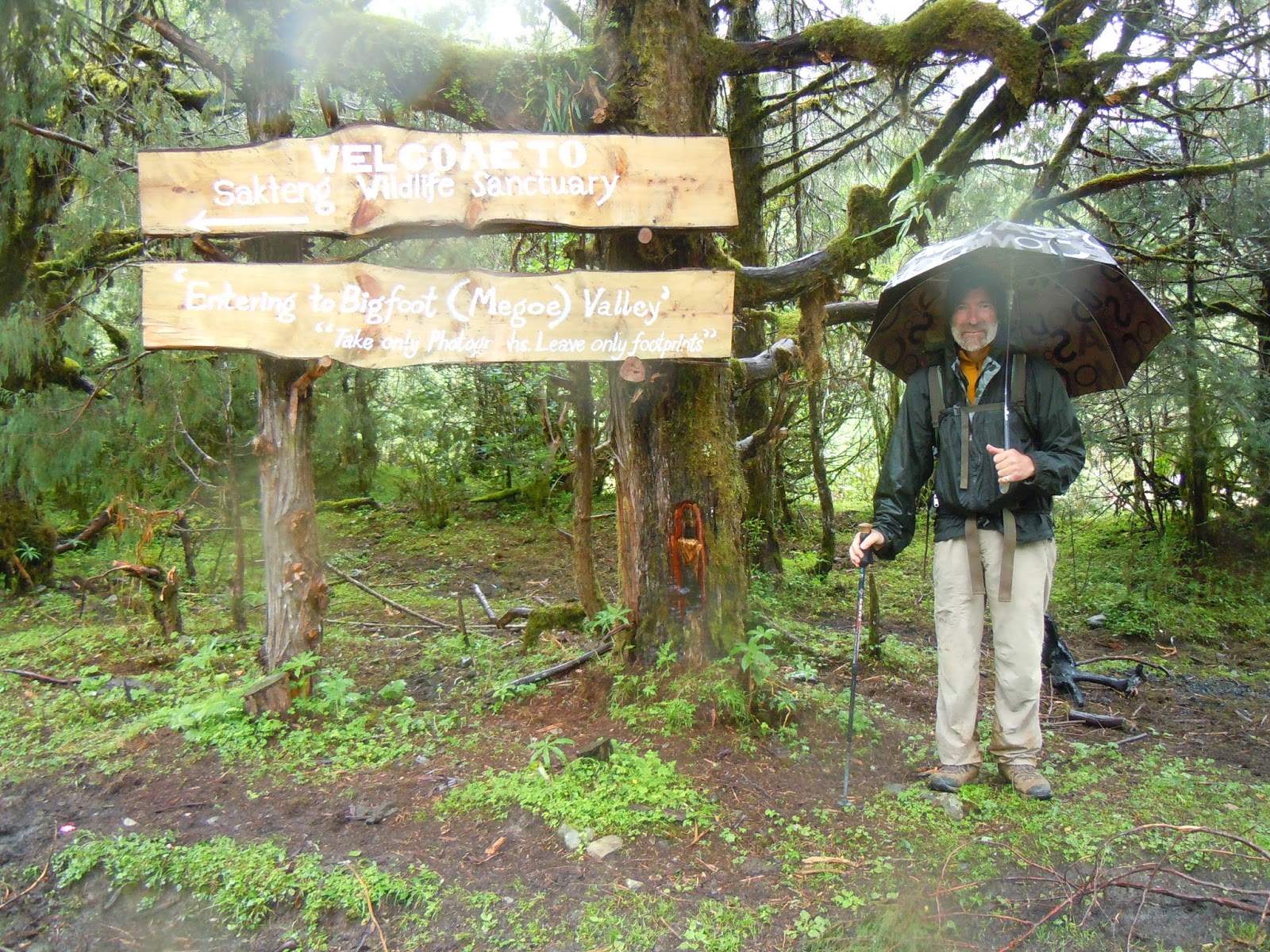 |
| Brick at the "entrance" to the Sanctuary. I don't think very many people, other than locals, have seen this sign. It reads: "Welcome to Sakteng Wildlife Sanctuary. Entering to (Migoe) Bigfoot Valley" |
 |
| The trail paralleled the Dongme Chhu (or Damnongchhu) for many kilometers. |
Beyond that point, the landscape changed and
the hiking became more like walking and the rain stopped. Then,
unaccountably, there by the riverside in what felt to us like the
middle of nowhere, someone had painted stunning, detailed portraits
of the Buddha, Guru Rinpoche and Chenrezig, the emanation of
compassion. The paintings weren't quite completed; the staging the
painter was using was still there, as were some of his tools. At the
edge of the river, the painter had erected a rude shelter with a tarp
and some branches, the floor strewn with juniper boughs (burned by
Buddhists as offerings) and we sat under the tarp to appreciate his
art. I would have been content to sit there for a long while; my
back and shoulders were knotting up miserably and I couldn't adjust
the pack to fit better--but Brick was anxious to get moving: the sun
was beginning to sink behind the mountains, so we continued on.


Sangay
insisted we were getting close to Merak, but in Bhutan "close"
and other references to distance have little meaning, so we didn't
give credence to his assurances. We came across a man in bright blue
gumboots carrying an empty bamboo basket that most farmers use to
carry everything from cattle feed to manure (carrying an empty basket
is considered bad luck; maybe he had something in the bottom of it because after we met him, our luck improved markedly). He also joined our parade, chatting now and
again with Sangay and the mute man with the horse and smiling at me
and Brick in that warm, welcoming way Bhutanese smile.
Somehow, we
came to a point where Sangay knew we were only 6 kilometers from
Merak. As our shadows lengthened ominously and my back screamed in
pain and my energy flagged, I asked the mute man if I could put my
pack on his horse for the last leg of our trek. Sangay negotiated,
and in the end, the man with the blue boots took my pack, affording
me indescribable relief. The sun, hidden for the ten hours we'd been
hiking, suddenly emerged from the mist, warming our soggy bones for
the first time in days.
We entered a
tiny village called Gangu, and off in the distance in a wide,
treeless expanse hanging off the side of the mountain, we could see
Merak.
 |
| The whole group (except Brick; he took the photo) and a local at Gangu. |
 |
| Entering Merak. It is said that one of the stones on the path into Merak is where Aum Jomo, the local deity, stopped to rest and left the print of her vagina on the rock. |
 |
| The sun came out at the edge of Merak. |
Brick went
to talk to him as Sangay and I rested, and when he returned we had a
place to sleep: the floor of a classroom.
The Principal also told us that after we stashed our gear we should come to his house to get a water boiler so we could heat our noodles. When we got to his house, warmed by the fire in his Bukhari, essentially a wood stove vented through the ceiling, he took pity on us and had his wife and niece feed us eggs cooked in at least eight tablespoons of butter, saag, rice, tea, and, for Brick, a form of Batu, or meat soup with homemade noodles. We could barely keep our eyes open seated by the warm, dry fire with full bellies. It was splendid.
 |
| First night's lodging. Sangay went to stay with his brother. |
The Principal also told us that after we stashed our gear we should come to his house to get a water boiler so we could heat our noodles. When we got to his house, warmed by the fire in his Bukhari, essentially a wood stove vented through the ceiling, he took pity on us and had his wife and niece feed us eggs cooked in at least eight tablespoons of butter, saag, rice, tea, and, for Brick, a form of Batu, or meat soup with homemade noodles. We could barely keep our eyes open seated by the warm, dry fire with full bellies. It was splendid.
We went to
sleep at 9:30 with a plan to spend the following day exploring Merak.
Blessedly, as we nodded off, there was no sound of rain.
 |
| A train of pack horses from Tashigang entering Merak. All goods have to be packed in except what can be grown or made in Merak. |
 |
| Me and Brick. Very wet. |




.jpg)


.jpg)